“Essentially what photography is life lit up.” — Sam Abell
Thank you for all the new views and likes from last week. It helps keep me going. Enjoy my blog post!
Enjoy this week’s rambling mind of a mechanical engineer and photographer.
Sunday, 06/06/2021: Posted photo — Cross.
Settings: Samsung SM-G930V (Galaxy S7), ISO 50, f/1.7, 1/415 s, 4 mm
This carving of a cross on the backrest of one of the chairs in the choir loft at church. Taken today since I needed a photo. I took this one just in case I did not have the opportunity to take another one today.

If you go to my post “Photographic Thoughts—03/14/2021 to 03/20/2021” you will be able to read my explanation on the difference between a cross and a crucifix.
Monday, 06/07/2021: Posted photo — Mountain Laurel.
Settings: Canon EOS 60D, ISO 400, f/7.1, 1/320 s, 135 mm
“Mountain laurel (Kalmia latifolia) is flowering broadleaf evergreen shrub with a gnarly, multi-stemmed growth habit. It has beautiful spring blooms, and its elliptical, glossy deep-green leaves (resembling those of rhododendrons) and gnarled stems make it attractive in all seasons. This shade-loving shrub produces clusters of rose, pink, or white flowers with purple markings in late May to early June.” — The Spruce website
The mountain laurel in this photo is from a shrub that we transplanted many years ago. I am amazed about how hardy mountain laurels are. This shrub has taken a beating over the years and is still blooming.
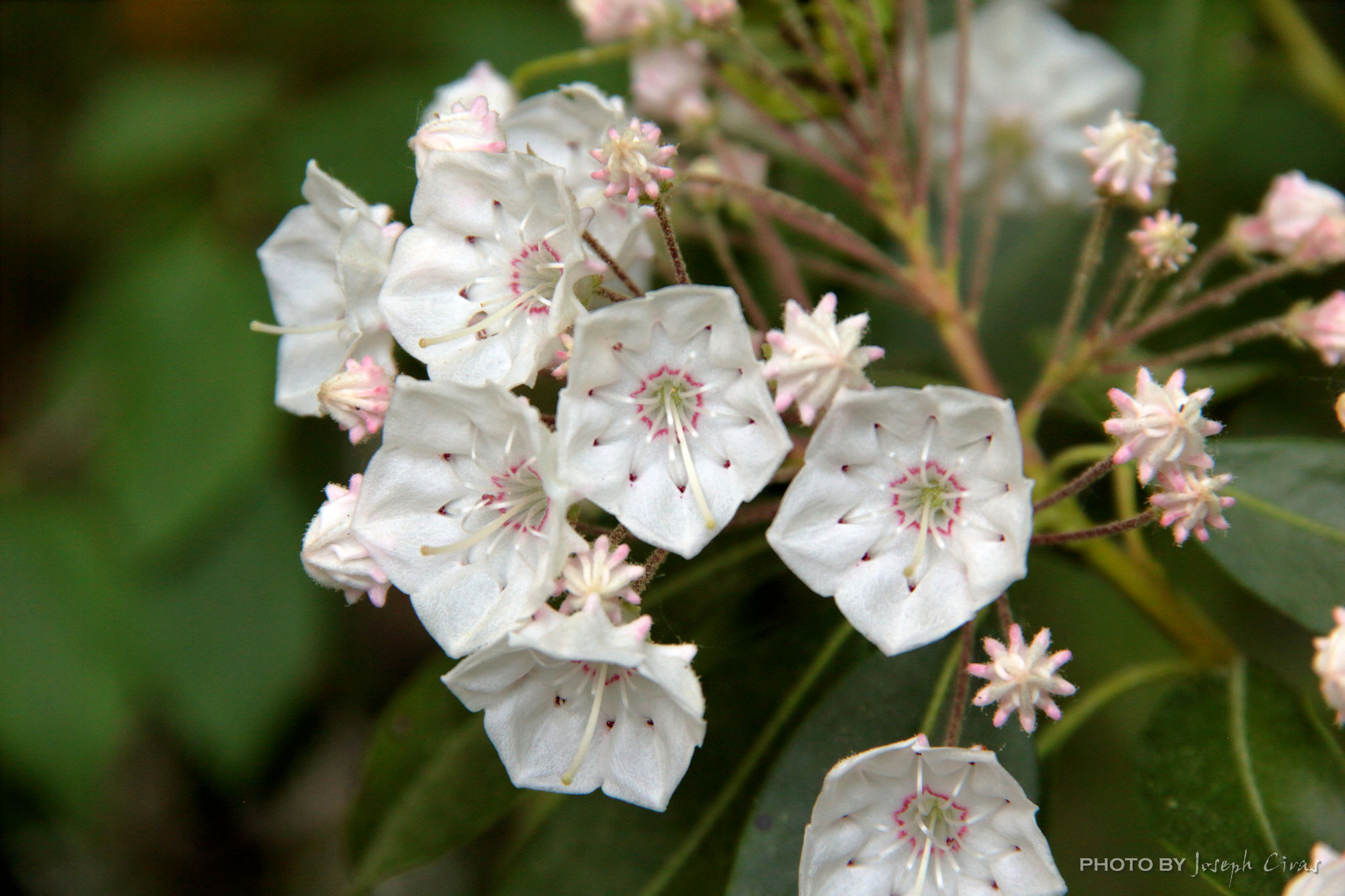
One of the items that impress people is how delicate the flower is on this shrub. We have white and pink mountain laurel in our yard and in the neighborhood. The white ones bloom first, then the rose, then the pink.
Tuesday, 06/08/2021: Posted photo — Daisies.
Settings: Canon EOS 60D, ISO 400, f/7.1, 1/320 s, 48 mm.
“Daisies are a popular choice for gardens—and for good reason. Bright, cheerful, and easy to grow, the flowers are readily identifiable and are mainstays of cottage gardens and classic perennial borders alike. The common name “daisy” is applied to a large handful of species among several genera within the huge Asteraceae family of plants, a group known for blooms that are flat and disc-shaped, with petals that form rays projecting outward from a central hub. The family also includes chrysanthemums, zinnias, asters, and sunflowers as well as a number of common weeds, such as dandelions. However, the daisy species that’s best for your flower garden depends on several factors. A daisy that’s perfect for one growing zone might be a total pest in another.” — The Spruce website
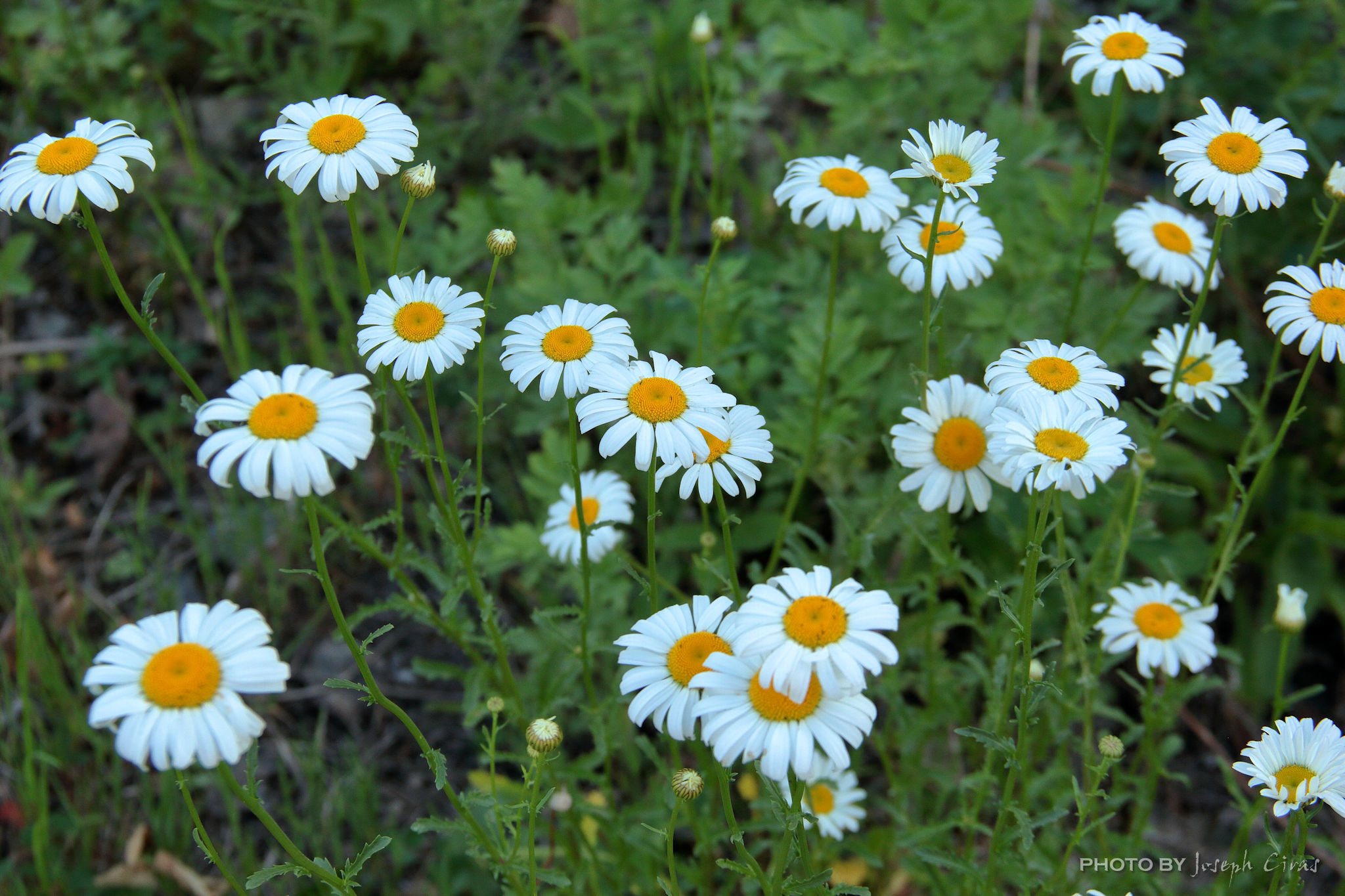
There are daisies growing in many locations in this area. I spotted these on the side of the road during one of my walks. The daisy symbolizes purity and innocence, and it can also stand for new beginnings. The meaning of the flower is “loyal love”.
Wednesday, 06/09/2021: Posted photo — Multiflora Rose.
Settings: Canon EOS 60D, ISO 100, f/7.1, 1/400 s, 75 mm.
Multiflora rose (Rosa multiflora), an invasive species, is a deciduous shrub with white flowers and red fruit. Brought here from Asia, it was planted as wildlife food, and also as a living fence, due to its dense growth and sharp thorns. It can grow to 10 feet high or more, and is typically wider than it is tall.
It forms dense thickets in fields and field edges, crowding out other species. It also grows in open wetlands and in forests where canopy openings occur. — Massachusetts Audubon Society
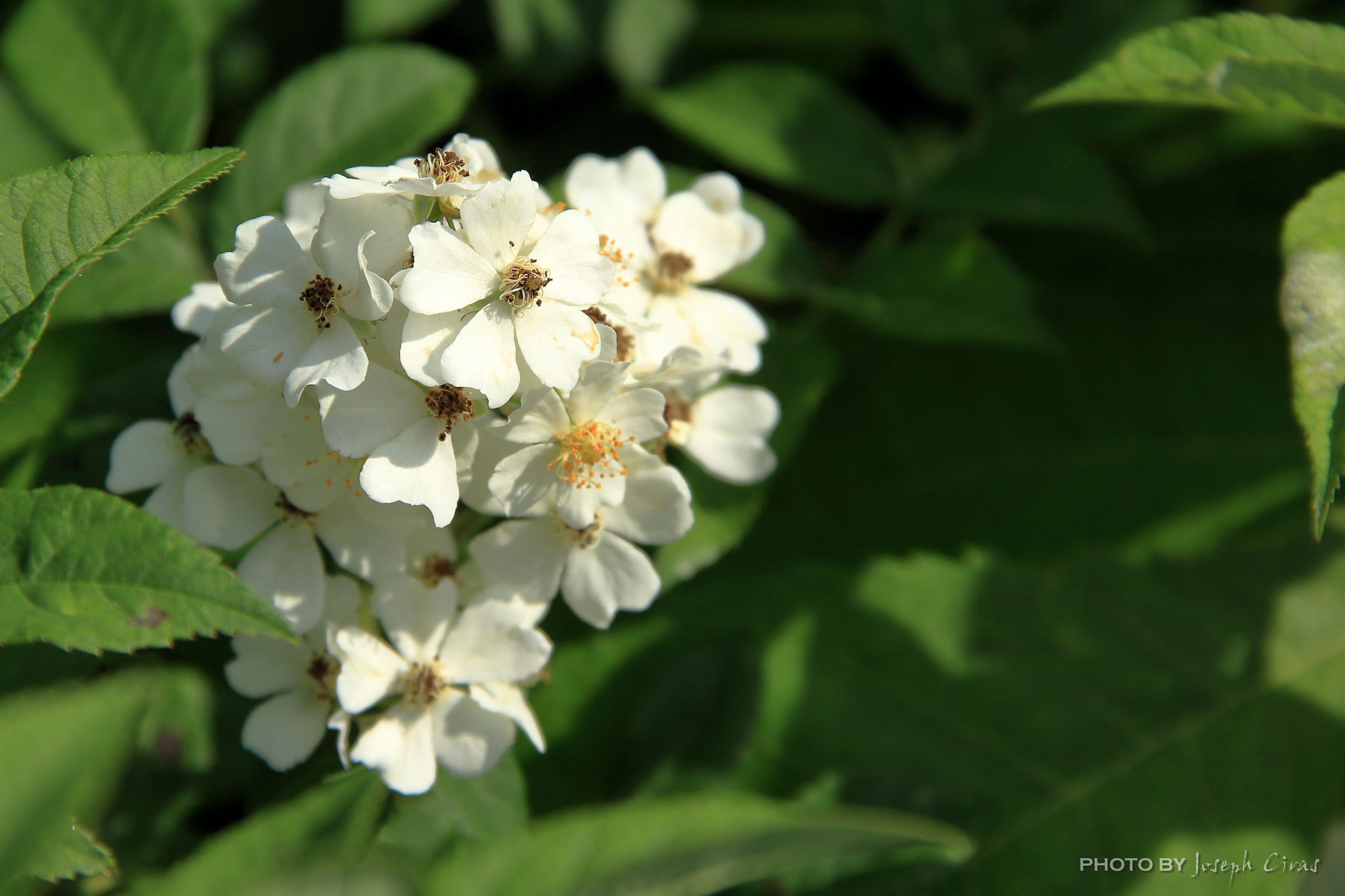
The multiflora rose in this photo is at my mother’s house. I like it because of the contrasting colors between the white and the green. An invasive species is an introduced organism that negatively alters its new environment. Although their spread can have beneficial aspects, invasive species adversely affect the invaded habitats and bioregions, causing ecological, environmental, and/or economic damage.
Thursday, 06/10/2021: Posted photo — Partial Solar Eclipse.
Settings: Canon EOS 60D, ISO 400, f/9, 2 s, 300 mm.
Here is the best photo of this morning’s partial solar eclipse. I think the clouds give it character.
“During a partial solar eclipse, the Moon, the Sun and Earth don’t align in a perfectly straight line, and the Moon casts only the outer part of its shadow, the penumbra, on Earth. From our perspective, this looks like the Moon has taken a bite out of the Sun.
Solar eclipses occur 2–5 times a year and they are usually named for their darkest, or maximum, point. Both total and annular solar eclipses are seen as partial eclipses from the areas on Earth that are outside the Moon’s inner shadows, the umbra or antumbra, but inside the penumbra (outer shadow).” — Time and Date website
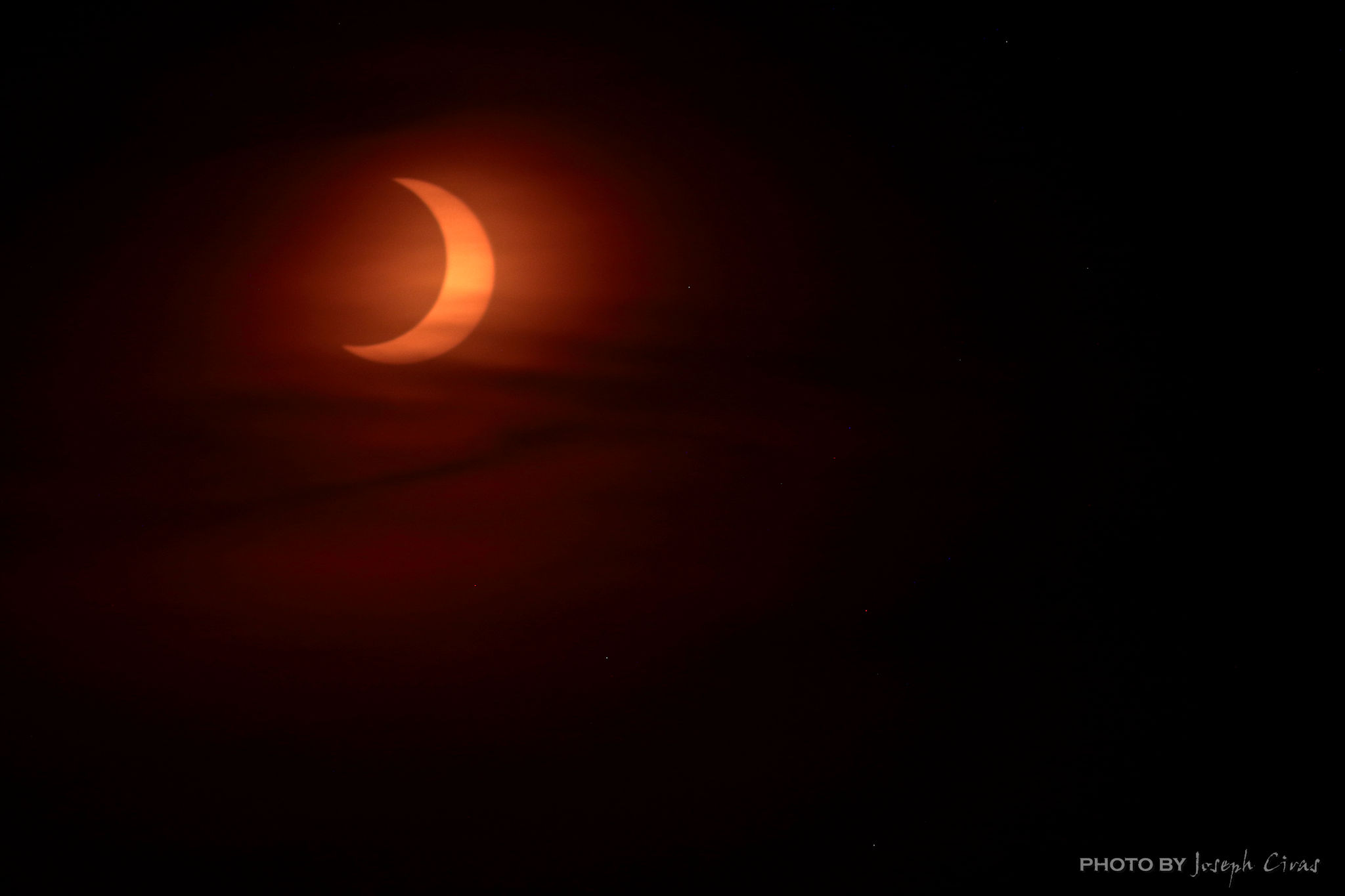
I took many photos of the eclipse this morning. Most of them were not in focus. This was the best one. I have a special solar filter for my lens. Without the special filter, the sensor in my camera could have burned out. I purchased this filter when my family went to see the total solar eclipse a few years ago. Solar filters are constructed to not only sufficiently dim the sunlight, but they also protect your eyes and equipment from non-visible IR and UV radiation.
One word of advice — if you are taking a photo of an eclipse, it is not good to stand on a bridge. I noticed during some of my longer exposure shots that the camera was shaking slightly due to the traffic under the bridge and the occasional vehicle traveling over the bridge.
Friday, 06/11/2021: Post photo — Hope.
Settings: Canon EOS 60D, ISO 200, f/4.5, 15 s, 18 mm.
Hope. We made the work “hope” out of luminaria for Relay for Life. Relay for Life (RFL) is a fundraiser for the American Cancer Society. My family has been participating in the RFL for many years.
The RFL is normally held at a local college. Due to the pandemic, it has been held at home for the last two years. If you notice, each letter of hope has a different color in it to have it stand out better in the photo.

Everyone knows someone who has been touched with cancer. If you would like to donate, contact me in the comments below and I will send you a link to our team.
Saturday, 06/12/2021: Post photo — Markers.
Settings: Canon EOS 60D, ISO 3200, f/5.6, 1/40 s, 100 mm
Today is the second day for Relay for Life at home and I wanted to take a quick photo before I went on my hike and then fell asleep. I saw the markers that we used to write on the luminary bags and liked the arrangement of colors.

For your information, here are the meanings of the different colors.
Red: The color of passion and energy.
Orange: The color of enthusiasm and emotion.
Yellow: The color of happiness and optimism.
Green: The color of harmony and health.
Turquoise: The color of calmness and clarity.
Blue: The color of trust and loyalty.
Purple: The color of spirituality and imagination.
Pink: The color of love and compassion.
Brown: The color of stability and reliability.
Black: The color of power and sophistication.
Gray: The color of compromise and control.
White: The color of purity and innocence.
I am not sure when I will post my blogs for the next two weeks due to commitments. I will see if I can post a partial blog later in the week and follow up with an update to that blog.
That is all for now. Until next week, be safe.
For more photo of other project I have work, visit my website: https://photobyjosephciras.weebly.com/ or visit me on Facebook at https://www.facebook.com/PhotobyJosephCiras/.
COVID is real! Be safe out there, keep your social distance, and remember to always wear your mask and wash your hands. Get your vaccine!
 Photo by Joseph Ciras
Nice job capturing the eclipse.
Thank you. Glad we found the solar filter for the camera.
Wonderful collection!